
Legal Research Assistant
Ask in plain English. Get case law, statutes and regulator guidance with pinpoint citations.
Read the agreement before you read the agreement
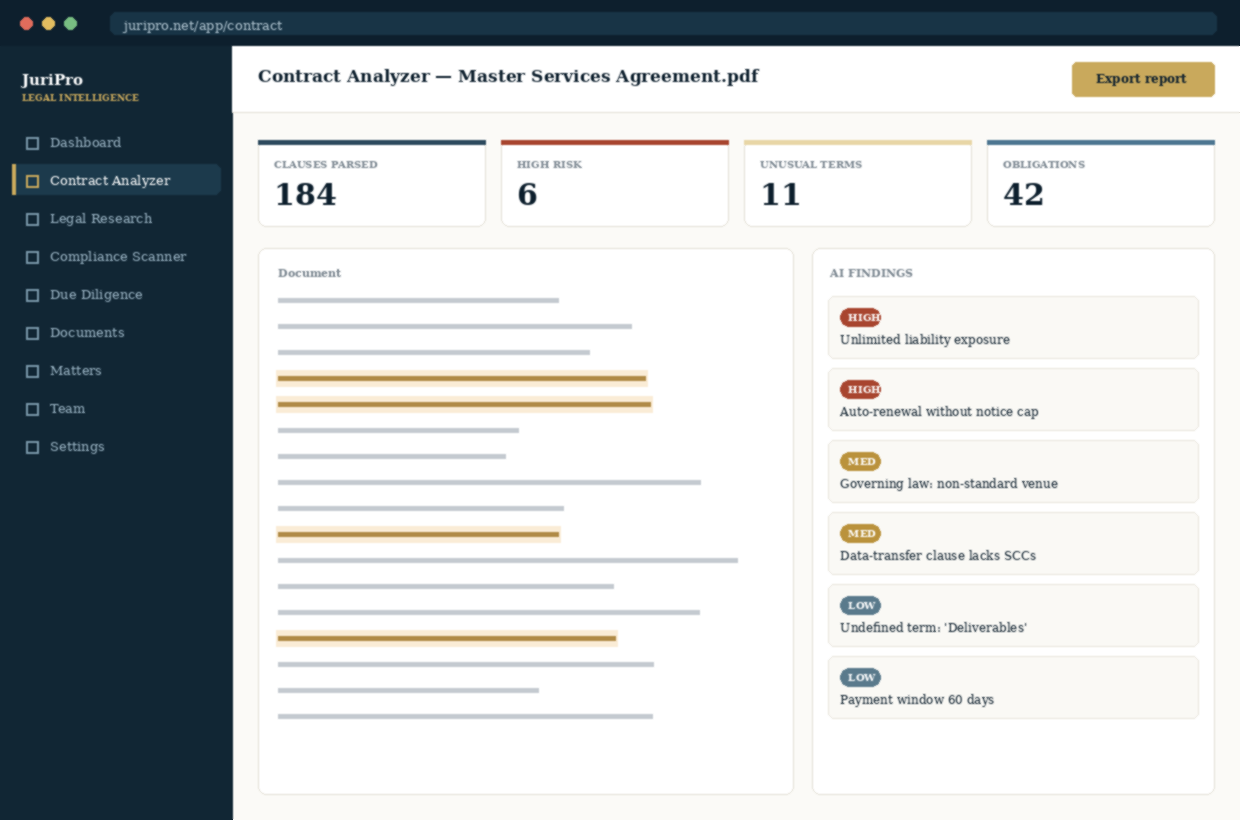
The Contract Analyzer takes an agreement in any common format and returns a structured account of what it says: which clauses are present, which are missing, which deviate from your standard position, and which obligations someone will have to diarise. It is designed for the first pass — the part of contract review that consumes the most time and generates the least intellectual satisfaction.
Contract Analyzer AI is included in the Professional plan at $149 per user per month, and available on Starter as a single-module licence.
On upload, the document is segmented into clauses using a layout-aware parser that handles numbered schedules, cross-references and the deeply nested definitions that defeat naive text splitting. Each segment is classified against a taxonomy of more than 240 clause types, from the everyday (governing law, assignment, notices) to the specialised (MFN, most-significant-customer, benchmarking, step-in rights).
The classified clauses are then compared against two references: market-standard language drawn from our corpus, and your own playbook if you have loaded one. Deviations are scored for materiality and grouped into a ranked findings list, each anchored to the exact passage that produced it.
A playbook in JuriPro is a set of positions expressed in plain language — your preferred wording, your acceptable fallback, and the point at which the matter has to be escalated. You can build one from scratch, import it from a spreadsheet, or let the system infer a draft from a set of agreements you have already signed and approve it clause by clause.
Because the playbook is versioned, you can tell exactly which position was in force when a given report was produced. That matters more than it sounds: when a negotiation is reviewed eighteen months later, the question is rarely what your standard is now.
Beyond risk, the analyser extracts the operative facts a contract manager needs: commencement and expiry dates, notice periods and their calculation basis, renewal mechanics, liability caps and their carve-outs, payment terms, service credits, and any condition precedent that has to be satisfied before something else happens.
These are exported as a structured obligation register — CSV, Excel, or pushed into your matter management system through the API — so that the diary entries get made by a system rather than by whoever remembers.
Redlines tell you what changed. They do not tell you what it means. JuriPro compares two versions of an agreement and produces a plain-English summary of the substantive movement: the cap moved from twelve months’ fees to six, the data protection indemnity became mutual, the termination notice period doubled. Formatting churn is filtered out.
On our public benchmark of 1,200 commercial agreements, top-level clause classification reaches 94% precision and 91% recall against a two-lawyer gold standard. Materiality scoring is deliberately conservative: we would rather surface a finding you dismiss than hide one you needed. Full methodology is available under NDA.
Yes. Scanned documents are processed with OCR and confidence-scored; where OCR confidence is low for a passage, findings drawn from it are marked so a reviewer knows to check the original.
No. Customer documents are processed in an isolated tenant and are never used to train shared models. This is a contractual commitment in our DPA, not a setting.
It is retained for as long as your retention policy specifies and then irreversibly deleted, including from backups within 35 days. You can delete any document or matter immediately from the interface or via the API.
Ask in plain English. Get case law, statutes and regulator guidance with pinpoint citations.
Continuous GDPR, CCPA/CPRA and SOX readiness checks across your document estate.
Turn a chaotic M&A data room into a structured findings report your deal team can act on.
Jurisdiction-aware templates with AI-assisted drafting, clause libraries and version control.
Start a 14-day trial with no credit card, or book a 30-minute walkthrough with a member of our legal engineering team.